Person-Centred Design Principles for Robust Specialist Disability Accommodation in Australia
- ROOT
- Articles
- Wednesday, 13 May 2026 13:19
- Wednesday, 13 May 2026 13:19
- Gary J Finn
- Hits: 3322
Person-Centred Design Principles for Robust Specialist Disability Accommodation in Australia
Specialist Disability Accommodation, known as SDA, provides purpose-built housing for NDIS participants with significant functional impairments or high support needs. Within the SDA framework, the robust design category addresses participants who may exhibit behaviours of concern. These behaviours can be triggered by environmental factors, making thoughtful design essential for safety, dignity and positive outcomes.
The NDIS SDA Design Standard, first released in 2019, sets clear expectations for all design categories. Robust SDA goes further by requiring designs that actively support residents while protecting staff and neighbours. Success depends on placing the individual at the centre of every decision.
Why a Person-Centred Approach Matters
Person-centred design starts with genuine understanding of each resident. It recognises that every person has unique preferences, triggers and goals. When design teams listen first and design second, the resulting homes reduce incidents, improve quality of life and deliver better value for providers and investors.
Research and practice across Australia show that robust SDA performs best when it feels like a real home rather than an institution. Residents who have choice and control experience greater independence, stronger relationships and improved mental health. Providers benefit from lower staff turnover and reduced property damage.
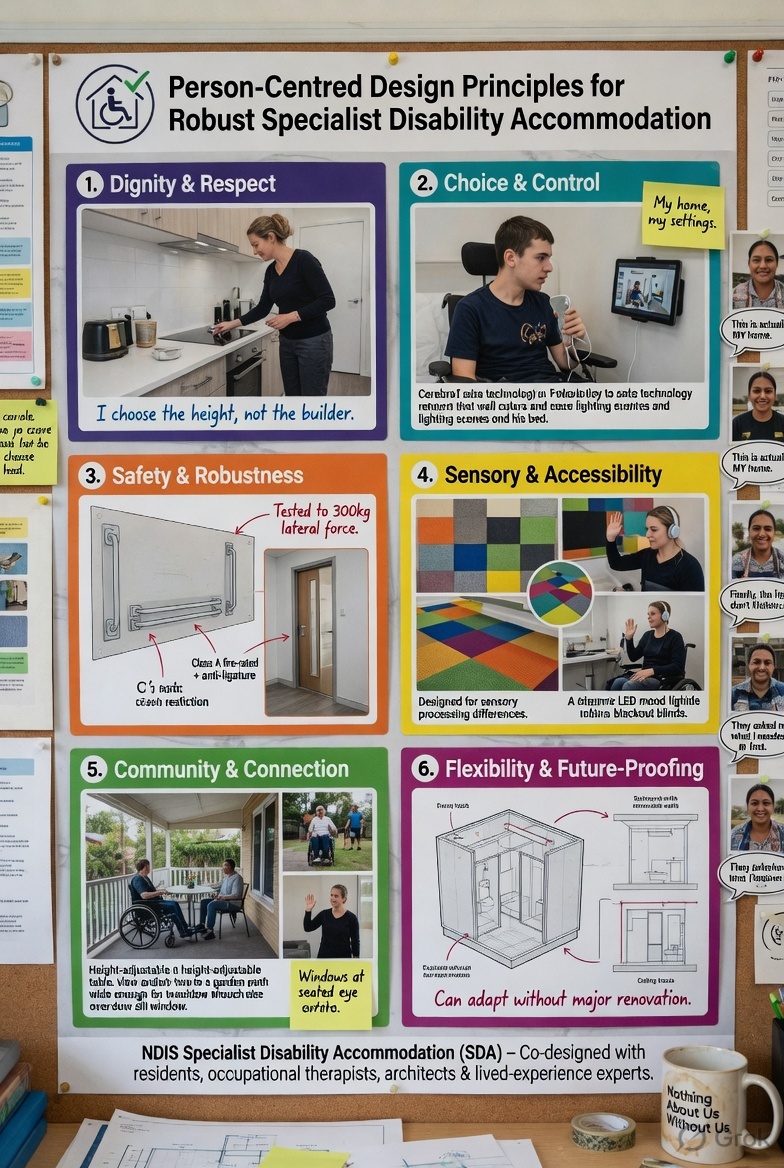
Seven Core Design Principles for Robust SDA
The following principles, drawn from leading Australian guidance on robust SDA, provide a practical framework for architects, developers and access consultants.
1. Enable a Person-Centred Co-Design Approach
Involve future residents, families and support teams from the earliest concept stage. Use real-life scenarios and sensory profiles to test every design choice. This collaborative process uncovers hidden needs that standard templates miss.
2. Create a Homelike Space
Avoid clinical finishes and institutional layouts. Use domestic-scale rooms, familiar materials, natural light and private outdoor areas. A homelike environment lowers anxiety and helps residents feel safe and valued.
3. Maximise Independence and Freedom
Design for the highest possible level of autonomy within safe boundaries. Wide, clear pathways, intuitive controls, private bedrooms with lockable doors and accessible bathrooms all support dignity and self-reliance.
4. Maximise Safety and Comfort
Identify and mitigate environmental triggers such as excessive noise, harsh lighting, sharp corners or confined spaces. Incorporate calming colour palettes, acoustic treatments and robust yet attractive fixtures that withstand wear without looking institutional.
5. Support Choice and Options for Interaction
Provide flexible spaces that allow residents to choose between solitude and social engagement. Quiet retreat areas, small group living zones and adaptable communal spaces respect individual preferences and changing daily needs.
6. Enable Effective Support Delivery
Design staff facilities, medication storage, quiet offices and clear sightlines that support high-quality care without compromising resident privacy. Good support infrastructure reduces stress for both residents and workers.
7. Deliver Adaptable and Flexible Design
Build in future-proofing. Modular layouts, adjustable fixtures and spaces that can be reconfigured as resident needs evolve protect long-term investment and minimise costly retrofits.
Alignment with the NDIS SDA Design Standard
These principles complement the requirements of the NDIS SDA Design Standard. The Standard emphasises performance outcomes rather than rigid prescriptions, giving skilled designers room to innovate while meeting certification benchmarks. When person-centred robust principles are applied early, projects achieve faster approvals, smoother certification and stronger long-term performance.
Practical Outcomes for Australian Projects
Developers and architects who embrace these principles report fewer behavioural incidents, higher occupancy rates and stronger relationships with NDIS participants and their families. Robust SDA that feels like home also attracts and retains quality support staff, a critical factor in regional and metropolitan markets alike.
Our Experience Delivering Person-Centred Robust SDA
Sydney Access Consultants has supported numerous SDA projects across New South Wales, applying these exact principles from concept through to certification. Our team understands both the technical requirements of the NDIS SDA Design Standard and the human factors that determine real-world success.
On the Mid North Coast of NSW, our local access consultant Sandy Gray works directly with regional clients and communities. Based at Black Beach, Sandy provides on-the-ground expertise for projects that need practical, place-sensitive solutions while meeting national SDA benchmarks.
We also assist clients in Perth and throughout Western Australia. Our advice respects local planning contexts, community expectations and the distinct character of Western Australian projects, delivering inclusive outcomes without imposing a one-size-fits-all approach.
Whether your project is a new group home, a robust SDA dwelling or a larger residential development incorporating SDA, early engagement with qualified access consultants ensures the design meets both regulatory requirements and the deeper needs of future residents.
Next Steps for Your SDA Project
Applying person-centred robust design principles from the outset reduces risk, improves participant outcomes and strengthens your project’s long-term value. Our team brings deep experience across the full spectrum of SDA categories and is ready to partner with architects, developers and providers nationwide.