Articles
Co-Living Housing in NSW: 15 Essential FAQs for Developers, Architects, and Residents
- ROOT
- Articles
- Thursday, 26 February 2026 06:01
- Thursday, 26 February 2026 06:01
- Administrator
- Hits: 7715
Co-Living Housing in NSW: 15 Essential FAQs for Developers, Architects, and Residents
Co-living housing has emerged as a dynamic solution to NSW's housing challenges, offering shared spaces that promote community while providing private retreats. As urban density increases and lifestyles evolve, co-living developments are gaining traction under the State Environmental Planning Policy (Housing) 2021 (Housing SEPP). However, ensuring these spaces are inclusive and compliant with accessibility standards is crucial for long-term success and regulatory approval.
At Sydney Access Consultants, we specialize in bridging architectural design with disability access expertise. Our team, including qualified access consultants like Alexandra (Sandy) Gray on the Mid North Coast and our partners in Sydney and Perth, helps ensure co-living projects meet Australian Standards such as AS 1428.1 (Design for Access and Mobility) and the National Construction Code (NCC) Volume One. This not only minimizes compliance risks but also enhances liveability for all residents, including those with disabilities.
Whether you're an architect designing a co-living space in Sydney's bustling suburbs or a developer eyeing opportunities in Perth's growing market, understanding the basics is key. Below, we answer 15 frequently asked questions based on the latest Housing SEPP amendments (as of 2026) and NSW planning guidelines. These insights draw from our extensive experience in adaptable housing and inclusive design, ensuring your project aligns with current building codes.
1. What is co-living housing in NSW?
Co-living housing is a form of residential accommodation with at least 6 private rooms (each for individual or shared occupancy by no more than two adults), plus shared communal facilities such as living areas, kitchens, and laundries. The rooms and shared spaces must be fully furnished and ready-to-occupy, with on-site or readily contactable management to foster community. It is designed as a primary place of residence (minimum 3 months), not short-term tourist accommodation. From an accessibility perspective, incorporating features like wider doorways and level access in communal areas (per AS 1428.1) can make these spaces truly inclusive.
2. How does co-living differ from boarding houses?
Both fall under similar built-form standards in the Housing SEPP, but key differences include: co-living has no mandatory affordability requirement, receives a smaller Floor Space Ratio (FSR) bonus (10% vs 30% for boarding houses), typically features larger/more self-contained private rooms (often with ensuites/kitchenettes), and emphasises community-building management. Accessibility-wise, co-living's focus on larger rooms offers opportunities for adaptable designs compliant with AS 4299 (Adaptable Housing), which our consultants recommend for future-proofing.
3. Where is co-living housing allowed in NSW?
It may be carried out (with development consent) on land where co-living housing, residential flat buildings, or shop top housing is permitted under the local environmental plan (LEP), another EPI, or under specific Housing SEPP chapters (e.g. low and mid-rise housing areas or TOD precincts). Recent amendments (2025) clarified permissibility in certain R2 and R3 zones where residential flat buildings are allowed via low/mid-rise or TOD provisions. In areas like the Mid North Coast, where our partner Sandy Gray operates from Black Beach, local projects can benefit from tailored access audits to navigate zone-specific requirements.
4. What are the minimum development standards for co-living housing?
Clause 69 of the Housing SEPP sets standards including: minimum private room sizes (typically 12–25 m² excluding any private kitchen/bathroom), minimum communal indoor/outdoor space per occupant, bicycle parking (where required by council), waste management, and management presence (manager contactable 24/7, though not necessarily on-site full-time). We advise integrating NCC accessibility clauses early, such as ensuring 20% of rooms meet Livable Housing Design Guidelines Silver level for better market appeal.
5. Does co-living housing receive any planning bonuses or incentives?
Yes — a 10% bonus to the applicable floor space ratio (FSR) is available under the Housing SEPP, similar to boarding houses but at a lower rate. This can increase developable floor area on qualifying sites. For projects in Perth, where sensitivities around trading names like "Sydney" may arise, we focus on localized branding while leveraging these incentives to incorporate robust access features without compromising design.
6. Is co-living housing required to be affordable?
No — unlike some boarding house or social/affordable housing provisions in the Housing SEPP, there is no mandatory affordability component or requirement to involve a registered community housing provider. However, blending affordability with accessibility (e.g., NDIS-aligned designs) can attract diverse tenants and government partnerships, an area where our team's expertise shines.
7. Can co-living housing be used for short-term or tourist accommodation?
No — it must provide a primary place of residence and cannot be used for short-term rental accommodation (STRA) or tourist/visitor accommodation. It is explicitly excluded from the STRA exempt development pathway and register. This long-term focus allows for deeper integration of inclusive elements, such as tactile indicators and braille signage per AS 1428.2.
8. Does the Apartment Design Guide (ADG) or SEPP 65 apply to co-living developments?
Generally no — co-living housing is exempt from State Environmental Planning Policy 65 (Design Quality of Residential Apartment Development) and the Apartment Design Guide unless the relevant local environmental plan (LEP) specifically requires it. That said, voluntary adherence to ADG principles can enhance accessibility, and our audits often reference these for performance solutions.
9. What is the minimum site area or lot size for co-living housing?
Since the 2022 amendments, the minimum lot size is 600 m² in Zone R2 Low Density Residential and 800 m² on other land (simplified from earlier rules). Site area per room/occupant ratios also apply under Clause 69. For Mid North Coast sites, Sandy Gray's local knowledge ensures compliance with regional variations, including flood-prone area adaptations.
10. Is on-site parking required for co-living developments?
Car parking requirements are set by the local council's LEP and DCP. The Housing SEPP itself removed minimum bicycle and motorcycle parking mandates in 2022, but councils may still impose resident/visitor car parking depending on location (many inner/middle-ring sites have reduced or nil requirements due to transport access). We recommend accessible parking bays compliant with AS 2890.6 to support residents with mobility needs.
11. Who manages a co-living property and what are their responsibilities?
A manager (on-site or off-site) must be appointed and contactable 24/7. They are responsible for shared spaces, encouraging community, maintenance, and resident issues — similar to boarding house management but with a stronger community focus. Training managers on accessibility protocols, as per our capacity-building workshops, can prevent common issues like blocked pathways.
12. Can co-living developments include ensuite bathrooms or kitchenettes in private rooms?
Yes — many modern co-living designs include private ensuites and/or kitchenettes in rooms (unlike traditional boarding houses). This is permitted provided overall communal facilities meet the minimum standards. Ensuring these private features are accessible (e.g., roll-in showers per AS 1428.1) adds value, especially for NDIS participants.
13. How does the Low and Mid-Rise Housing Policy or Transport Oriented Development (TOD) program affect co-living?
Recent updates (2024–2025) expanded permissibility and removed barriers so co-living can benefit in low/mid-rise housing areas (within 800 m of town centres/stations) and TOD precincts where residential flat buildings are permitted, increasing opportunities in R2/R3 zones and near transport. In Perth's TOD zones, our emerging services emphasize sensitive, inclusive designs to align with local preferences.
14. What development application process applies to co-living housing?
Development consent is usually required via the NSW Planning Portal (local council determination for most projects; some larger/complex ones may be regionally or state-significant). Complying development is generally not available. Applications must demonstrate compliance with Clause 69 standards. Our team assists with access reports to strengthen DA submissions and avoid delays.
15. Can existing buildings (e.g., houses or motels) be converted to co-living housing?
Yes — adaptive reuse is common and encouraged, provided the development meets Housing SEPP standards (room sizes, communal areas, management, etc.) and obtains development consent. Heritage, fire safety, and building code upgrades often apply. Conversions offer a prime chance for accessibility retrofits, drawing on our expertise in AS 1428 series standards.
Co-living housing represents a forward-thinking approach to urban living in NSW, but overlooking accessibility can lead to costly revisions or non-compliance. As leaders in disability access consulting, Sydney Access Consultants (trading as GJ Finn & DW Wong) helps architects and developers integrate inclusive design from the outset—whether in Sydney, the Mid North Coast with Sandy Gray, or our expanding Perth market. For Malaysian parallels under MS 1184:2014, visit our sister site at accessconsultants.asia.
For site-specific advice, always check the local council's LEP/DCP, the current version of the Housing SEPP on legislation.nsw.gov.au, and the NSW Planning Portal. Pre-lodgement advice from council or a town planning consultant is strongly recommended for any proposed co-living project.
Comprehensive Checklist for Designing Co-Living Housing in NSW: Navigating the Housing SEPP 2021 (Updated for 2025/2026 Amendments)
- ROOT
- Articles
- Thursday, 26 February 2026 05:54
- Thursday, 26 February 2026 05:54
- Administrator
- Hits: 7489
Comprehensive Checklist for Designing Co-Living Housing in NSW: Navigating the Housing SEPP 2021 (Updated for 2025/2026 Amendments)
Co-living housing has emerged as a popular solution to NSW's housing affordability crisis, offering shared amenities and private rooms in a community-focused environment. Under the State Environmental Planning Policy (Housing) 2021—commonly known as the Housing SEPP, as amended up to 2025/2026—this development type provides incentives for diverse, high-amenity housing. However, navigating permissibility, non-discretionary standards, and local controls is crucial to secure approvals and avoid delays or appeals in the Land and Environment Court.
As specialists in architectural compliance and disability access consulting at Sydney Access Consultants, we help architects integrate inclusive design principles from the outset. This checklist draws from Chapter 3 Part 3 of the Housing SEPP (clauses 67–70), related provisions, and practical DA applications. It emphasizes mandatory requirements, non-discretionary standards (which prevent refusal if met), and best practices for amenity, character, and accessibility. Note: Co-living developments are exempt from the Apartment Design Guide (ADG) under SEPP 65/Housing SEPP Chapter 4, relying instead on SEPP standards, local Development Control Plans (DCPs), and merit-based assessments.
Whether you're designing in Sydney's urban centers, emerging Perth markets (where sensitivities to trading names like "Sydney" may require localized branding), or the Mid North Coast—where our partner Sandy Grey offers on-site expertise from Black Beach—this guide minimizes risks and enhances project outcomes. Always cross-reference the current consolidated Housing SEPP on the NSW Legislation website for precise clause wording, as amendments (e.g., 2025 diverse housing updates) continue to evolve.
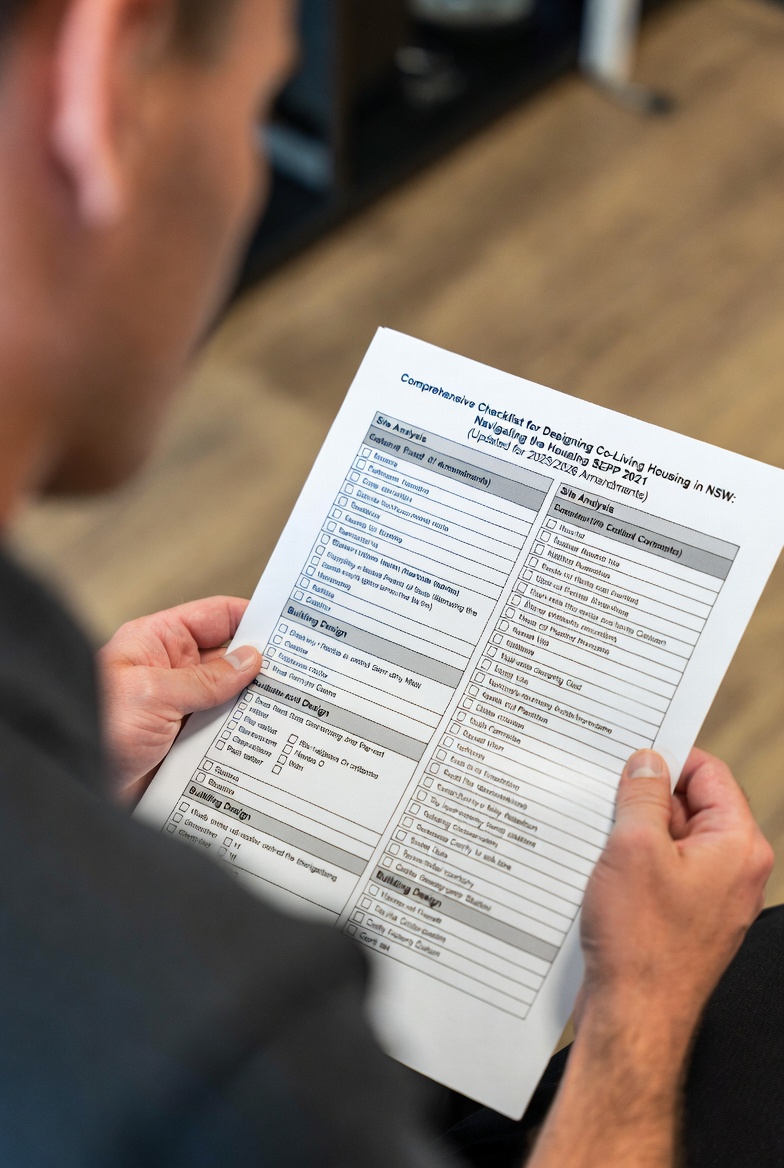
1. Site Suitability and Permissibility
Selecting the right site is foundational to a successful co-living project. Non-compliance here can lead to outright refusal, so verify early.
- Zoning Confirmation: Ensure the site is in a permissible zone, such as R3 Medium Density Residential, R4 High Density Residential, or B1–B4 business zones where residential flat buildings or shop top housing are allowed. Post-2025 amendments under Chapter 6 (Low and Mid-Rise Housing) explicitly permit co-living in these areas, aligning with transport-oriented development (TOD) goals.
- Minimum Lot Size: Sites must be at least 600 m² in R2 Low Density Residential zones (if locally permitted) or 800 m² elsewhere, per post-2022 simplification amendments. This supports efficient shared space integration.
- Site Frontage: Aim for a minimum of 17 m to facilitate access and vehicle maneuvering—check your local council's DCP for specifics, as narrower frontages can complicate approvals.
- Overlay Restrictions: Avoid sites with heritage conservation areas, flood-prone land, bushfire risks, or other environmental overlays that could prohibit development. Conduct early site audits to identify issues.
- Proximity to Amenities: Prioritize locations near public transport, services, and activity centers to meet local objectives. For Mid North Coast projects, Sandy Grey's local knowledge ensures alignment with regional character, boosting feasibility.
By addressing these early, you reduce assessment risks and position your project for incentives like FSR bonuses.
2. Core Definition and Operational Requirements
Co-living must meet the Housing SEPP's definition to qualify for streamlined approvals. Operational details are key to maintaining its residential character.
- Minimum Private Rooms: Include at least 6 private rooms, with some or all featuring private kitchens or bathrooms. This distinguishes co-living from other typologies like boarding houses.
- Occupancy Limits: Each room accommodates no more than 2 people, ensuring density aligns with amenity standards.
- Residency Focus: The development must serve as a principal place of residence with minimum 3-month tenancies. Prohibit short-term tourist accommodation through a robust plan of management to avoid reclassification as a hotel or serviced apartment.
- Furnishing and Readiness: Provide fully furnished private rooms and shared spaces, ready for immediate occupancy.
- Management Oversight: Appoint a 24-hour managing agent, detailed in the plan of management. This covers maintenance, security, and tenant rules.
- Exclusions: Differentiate from backpackers' accommodation, group homes, seniors housing, or hotels to comply with SEPP intent.
Incorporate these into your DA documentation to demonstrate compliance and prevent operational challenges post-approval.
3. Private Room Design (Non-Discretionary Standards)
Private rooms are the heart of co-living—meeting these minimums is non-discretionary, meaning consent authorities cannot refuse if achieved.
- Floor Area Minimums: 12 m² for single occupants (excluding private kitchen/bathroom) and 16 m² for doubles. These ensure basic livability without overcrowding.
- Maximum Room Size: While not strictly mandated, practice often caps rooms at around 25 m² to preserve the co-living ethos; review local DCPs for any caps.
- Natural Light and Ventilation: Every room must have access to natural light, ventilation, and outlook. Draw on solar access principles (similar to ADG) for defensibility in appeals, enhancing resident well-being.
These standards promote high-amenity designs, reducing vacancy risks in competitive markets like Sydney or Perth.
4. Communal Facilities and Amenity (Non-Discretionary Standards)
Shared spaces define co-living's appeal—failure here can undermine approvals, so prioritize usability and solar access.
- Indoor Communal Living Area: Provide at least 30 m² base plus 2 m² per additional private room beyond 6. Ensure a minimum 3 m dimension in each area for functional flow.
- Outdoor Communal Open Space: Target 20% of site area (or equivalent per post-amendments), integrated with landscaping for recreation.
- Shared Facilities: Include communal kitchens, bathrooms, and laundries if not provided privately. Scale to occupancy for equity.
- Solar Access: Achieve at least 3 hours of direct sunlight (9 am–3 pm mid-winter) to at least one communal living area, supporting mental health and energy efficiency.
- Landscaped Areas: Meet residential controls from DCPs or Chapter 6, with deep soil planting where possible.
These elements foster community while aligning with BASIX requirements for sustainability.
5. Built Form and Density Incentives (Non-Discretionary)
Leverage SEPP incentives to maximize yield without compromising form.
- Floor Space Ratio (FSR): Access the LEP maximum plus a 10% bonus if dedicated to co-living—ideal for infill sites.
- Building Height: Adhere to LEP limits (no standard bonus unless affordable housing is included).
- Setbacks and Separation: Follow residential flat building standards for privacy, akin to ADG separations, to mitigate neighbor impacts.
- Parking Provisions:
- Car parking: Lesser of LEP/DCP rates or 0.5 spaces per room in Greater Sydney (bicycle/motorcycle minimums were removed from SEPP in 2022—defer to local DCPs).
- Integrate EV charging and shared mobility for modern appeal.
- Bicycle and Motorcycle Parking: Provide at least 1 space per room or per 5 rooms, per DCP, to encourage sustainable transport.
These incentives make co-living viable in high-demand areas, from Sydney to regional NSW.
6. Other Design and Amenity Standards
Beyond non-discretionary elements, focus on merit-based aspects to strengthen your DA.
- Privacy and Acoustics: Ensure separation between rooms and neighbors, with noise mitigation for communal areas—critical for long-term livability.
- Accessibility and Universal Design: As access consultants, we strongly recommend incorporating Livable Housing Design Guidelines (Silver level or higher) for step-free entries, wider doorways, and adaptable features. Align with Australian Standards like AS 1428.1 (2021 edition) for accessible paths, and consider NDIS/SDA principles for inclusivity. This not only broadens market appeal but future-proofs against evolving Building Code of Australia (NCC 2025) requirements. For Mid North Coast projects, Sandy Grey's expertise in adaptable housing (AS 4299-1995) ensures seamless integration.
- Sustainability Features: Comply with BASIX for waste, energy, and water, incorporating best practices like green roofs.
- Landscape and Open Space: Design high-quality, usable areas with structured planting if site-constrained.
- Street Presentation: Activate ground levels with responsive materials and entries to enhance local character—key for council assessments.
- Plan of Management: Draft a comprehensive document covering operations, maintenance, and security.
These standards elevate your project, reducing appeal risks on amenity grounds.
7. Documentation and DA Readiness
Robust documentation is your best defense—prepare thoroughly for smooth processing.
- Compliance Statement: Include a clear address of non-discretionary standards to leverage "cannot refuse" protections.
- Design Statement: Respond to local character, heritage, and urban design (e.g., Clause 6.5 design excellence in some LEPs).
- DCP Cross-Referencing: Align with objectives on solar access, open space, and amenity, even if not mandatory.
- BASIX and Targets: Submit certificates demonstrating energy and water efficiency.
- Chapter 6/TOD Alignment: If in low/mid-rise or TOD precincts, confirm overrides apply (co-living permissible post-2025).
For complex sites, seek pre-DA advice and specialist input. At Sydney Access Consultants, our team—including qualified access experts like Sandy Grey—supports seamless compliance.
By following this checklist, architects can deliver compliant, inclusive co-living projects that meet NSW's housing needs. For tailored advice, especially on accessibility integrations, consider consulting specialists early in the design process.
Navigating Development Consent for Co-Living Housing in NSW: Essential Guide for Developers and Architects
- ROOT
- Articles
- Thursday, 26 February 2026 05:37
- Thursday, 26 February 2026 05:34
- Administrator
- Hits: 6218
Navigating Development Consent for Co-Living Housing in NSW: Essential Guide for Developers and Architects
Co-living housing has emerged as a popular solution to NSW's housing affordability crisis, offering shared living spaces that foster community while providing private rooms and communal amenities. However, constructing co-living developments in New South Wales isn't straightforward. Unlike traditional residential projects, co-living requires careful navigation of planning laws to ensure compliance and successful approvals. In this article, we'll break down the key requirements under the Environmental Planning and Assessment Act 1979 (EP&A Act) and the State Environmental Planning Policy (Housing) 2021 (Housing SEPP), with a focus on permissibility, consent pathways, and the often-overlooked role of accessibility in design. As specialists in inclusive design, we'll also highlight how integrating universal access principles from the outset can streamline your project and avoid costly revisions.
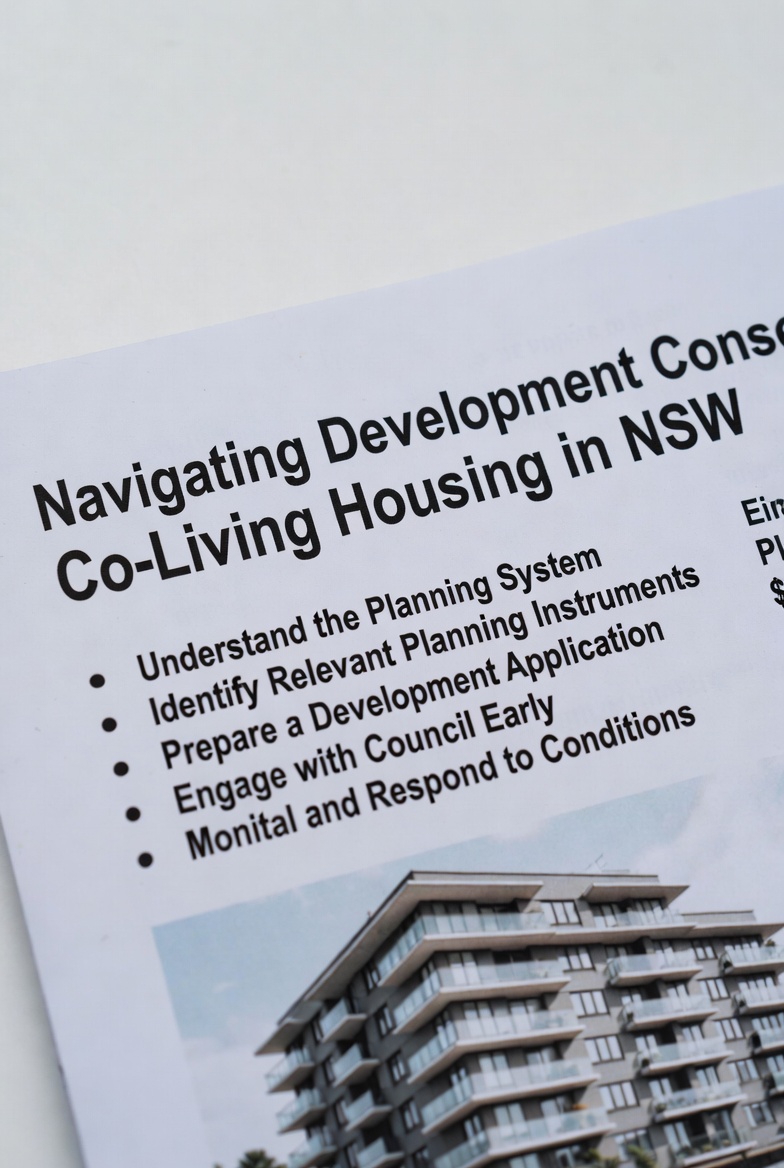
Understanding Co-Living Housing in NSW: What It Is and Why Consent Is Required
Co-living housing, as defined in the Housing SEPP, typically involves buildings with private rooms (minimum 12m² for singles or 16m² for couples) combined with shared kitchens, living areas, and outdoor spaces. It's designed for long-term residents with minimum three-month tenancies, distinguishing it from short-term accommodations like hostels or tourist housing.
Under the EP&A Act, co-living developments generally require development consent. They are not classified as exempt or complying development under the Housing SEPP or the State Environmental Planning Policy (Exempt and Complying Development Codes) 2008. This means every proposal must go through a full development application (DA) process, assessed against Section 4.15 of the EP&A Act, which considers environmental, social, and economic impacts.
Why no shortcuts? Exempt or complying pathways are reserved for low-impact developments like certain granny flats or group homes with strict size limits. Co-living's scale and shared nature demand thorough review to ensure it aligns with local character, infrastructure capacity, and amenity standards.
Key Provisions from the Housing SEPP: Permissibility and Zones
Chapter 3, Part 3 of the Housing SEPP outlines the core rules for co-living housing. As of the latest consolidated version (incorporating 2025 amendments for low and mid-rise housing reforms), Clause 67 permits co-living with consent in zones where:
- Co-living is explicitly allowed under another environmental planning instrument, or
- Residential flat buildings or shop top housing are permitted under Chapter 5 (Diverse Housing), Chapter 6 (Low and Mid-Rise Housing), or the local council's Local Environmental Plan (LEP).
This opens doors in zones like:
- R3 Medium Density Residential
- R4 High Density Residential
- Commercial zones such as B1 Neighbourhood Centre, B2 Local Centre, or B4 Mixed Use
Recent reforms have expanded permissibility near transport hubs and centres via Chapter 6, but co-living remains prohibited in R2 Low Density Residential zones to preserve suburban character.
| Zone Type | Permissibility for Co-Living | Examples |
|---|---|---|
| R3 Medium Density | With consent (if flats allowed) | Townhouses, villas, or apartments |
| R4 High Density | With consent | High-rise residential towers |
| B4 Mixed Use | With consent (shop top housing) | Developments above retail or offices |
| R2 Low Density | Generally prohibited | Single dwellings, dual occupancies |
Non-discretionary standards under Clause 68 provide bonuses and safeguards:
- Floor Space Ratio (FSR): Up to 10% bonus beyond the LEP maximum, if used exclusively for co-living.
- Room sizes, communal spaces, solar access, landscaping, and parking requirements ensure livability.
- Clause 69 mandates satisfaction of these before consent, but authorities can't refuse solely on non-compliance—they must weigh overall merits.
Subdivision into separate lots is banned under Clause 70 to maintain the shared model.
The Consent Process: Who Approves and What to Expect
The local council is usually the consent authority, handling DAs through standard processes. Exceptions include State Significant Development (SSD) for large-scale projects exceeding thresholds (e.g., over $30 million in capital value), but most co-living falls below this.
Assessment involves:
- Submission via the NSW Planning Portal, including plans, statements of environmental effects, and a plan of management (often conditioned for ongoing operations, like 24/7 manager availability).
- Holistic review under s 4.15, considering LEP zones, Development Control Plans (DCPs), and impacts like traffic or overshadowing.
- Potential integrated approvals from agencies (e.g., NSW Health for sanitation in shared facilities).
Local DCPs may add layers, such as design excellence or heritage considerations, but can't override SEPP non-discretionary standards. Appeals can go to the Land and Environment Court if refused.
Practical tip: Always verify the current Housing SEPP on legislation.nsw.gov.au, as 2025 updates aligned it with Transport Oriented Development (TOD) policies, potentially fast-tracking approvals near stations.
Accessibility Considerations in Co-Living Housing: Building Inclusive Communities
While the Housing SEPP focuses on planning, co-living must comply with the National Construction Code (NCC) 2022 (current as of 2026) for building standards, including accessibility under the Disability (Access to Premises—Buildings) Standards 2010. Co-living's shared spaces amplify the need for universal design—think accessible entries, bathrooms, and kitchens to accommodate diverse residents, including those with disabilities.
Key NCC clauses:
- Volume 1, Part D4: Access to and within buildings (e.g., ramps, lifts for multi-level co-living).
- AS 1428.1-2009 (Design for Access and Mobility): Minimum requirements for paths, doors, and sanitary facilities.
- Livable Housing Design Guidelines: Silver or Gold level recommended for co-living to future-proof against NDIS or aging-in-place needs.
Non-compliance risks delays or retrofits. For instance, communal areas must provide equitable access, avoiding "accessible units" in isolation. Performance solutions (alternative designs justified via expert reports) can offer flexibility, but require robust documentation.
As access consultants, integrating these early avoids common pitfalls like inadequate circulation spaces or non-compliant gradients, ensuring your co-living project not only gets consent but also delivers social value.
Practical Tips for Successful Co-Living Developments in NSW
- Site Selection: Target zones with existing flat building permissions. Use tools like the NSW Spatial Viewer to check LEPs.
- Pre-DA Advice: Engage councils early for feedback on bonuses or variances.
- Design Integration: Incorporate communal features (e.g., 25% indoor communal space) to qualify for FSR uplifts.
- Risk Mitigation: Prepare for objections on density or parking—strong traffic studies help.
- Sustainability Tie-In: Align with BASIX requirements for energy efficiency, enhancing appeal.
For site-specific guidance, review your suburb's LEP (e.g., Sydney LEP 2012 for inner-city zones). If heritage, flood-prone, or near sensitive areas, expect additional scrutiny.
Why Partner with Access Experts for Your Co-Living Project?
Co-living's emphasis on community demands designs that are truly inclusive. By embedding accessibility from concept stage, you comply with NCC standards, reduce approval risks, and attract a broader tenant base. Our team at Sydney Access Consultants specializes in performance solutions, audits, and compliance reviews tailored to diverse housing like co-living, drawing on Australian best practices to bridge gaps in local enforcement.
Whether you're an architect planning a medium-density project in Parramatta or a developer eyeing mixed-use in Newcastle, understanding these rules is key to success.
Understanding Co-Living Housing in NSW: A Comprehensive Guide to SEPP Compliance and Accessibility Standards
- ROOT
- Articles
- Thursday, 26 February 2026 05:23
- Thursday, 26 February 2026 05:23
- Administrator
- Hits: 6708
Understanding Co-Living Housing in NSW: A Comprehensive Guide to SEPP Compliance and Accessibility Standards
Co-living housing has emerged as a dynamic solution to Australia's urban housing challenges, offering affordable, flexible, and community-oriented living options. Introduced under the State Environmental Planning Policy (Housing) 2021 (Housing SEPP) in November 2021, this form of diverse residential accommodation is designed to meet the needs of young professionals, key workers, students, and others seeking compact, ready-to-occupy rentals in high-demand areas like Sydney and Perth. As urban populations grow and housing affordability remains a pressing issue, co-living developments are gaining traction for their ability to increase supply without compromising on quality or inclusivity.
In this guide, we'll break down the statutory definition, key characteristics, planning controls, and practical considerations of co-living housing. We'll also explore how accessibility plays a crucial role in these developments, ensuring they comply with Australian standards and promote equitable living environments. Whether you're an architect, developer, or potential resident, understanding these elements is essential for navigating NSW's regulatory landscape.
What is Co-Living Housing? Statutory Definition and Key Characteristics
Under the current consolidated Housing SEPP, co-living housing is defined as a building or place that meets specific criteria to function as long-term, primary residences rather than transient accommodations. Key elements include:
- Minimum Private Rooms: At least 6 private rooms, some or all of which may feature private kitchen and/or bathroom facilities.
- Residency Duration: Occupants must use it as their principal place of residence for at least 3 months. This distinguishes it from short-term options like Airbnb, hotels, or motels.
- Shared Facilities: Essential communal spaces such as living rooms, kitchens, bathrooms, or laundries, maintained by a managing agent providing 24-hour services.
- Furnishing and Readiness: The development must be fully furnished and ready-to-occupy, blending private and shared areas for a seamless living experience.
Importantly, co-living housing is explicitly not backpackers' accommodation, boarding houses, group homes, seniors housing, serviced apartments, or similar typologies. This focus on purpose-built rentals makes it ideal for urban infill projects, where space is at a premium but community interaction is encouraged.
For developers in Sydney or emerging markets like Perth, co-living offers a way to diversify housing stock. However, success hinges on balancing compactness with livability—factors that tie directly into accessibility compliance under the National Construction Code (NCC) and Australian Standards like AS 1428.1 (Design for Access and Mobility).
Minimum Room Sizes and Amenity Requirements for Occupant Well-Being
The Housing SEPP enforces non-discretionary standards to ensure high-quality amenities, preventing substandard developments. These include:
- Private Room Sizes: A minimum of 12 m² for single occupants or 16 m² for couples (excluding any en-suite kitchen or bathroom areas).
- Communal Spaces: Mandatory indoor and outdoor areas for relaxation and socialization, scaled to the number of residents.
- Facilities Provision: Adequate kitchens, bathrooms, and laundries—either private or shared—to support daily living.
- Management Oversight: A dedicated manager must implement a plan of management, covering maintenance, resident conduct, and dispute resolution.
Typical co-living projects feature 30–40 rooms, though the SEPP allows as few as 6, making it scalable for smaller sites. These standards align with broader goals of housing diversity, but they also intersect with accessibility requirements. For instance, under the NCC Volume One (Class 2 buildings), at least 20% of sole-occupancy units in multi-unit developments must be adaptable or accessible, per Clause D3.1 and AS 4299 (Adaptable Housing). This ensures co-living spaces cater to diverse needs, including those of people with disabilities.
Planning Controls, Permissibility, and Development Incentives
Co-living housing is subject to strict planning controls to integrate seamlessly into NSW's urban fabric:
- Zoning Permissibility: Allowed with consent in zones permitting residential flat buildings, shop-top housing, or—following 2025 amendments to Chapter 6—low and mid-rise housing. Common zones include R3 (Medium Density Residential), R4 (High Density Residential), and commercial areas like B1, B2, or B4. It's generally prohibited in R2 (Low Density Residential) zones.
- Density Bonuses: Developments receive a 10% floor space ratio (FSR) uplift above the Local Environmental Plan (LEP) maximum if dedicated solely to co-living.
- Built-Form Standards: Similar to boarding houses but with a smaller incentive (10% vs. 30%). Evaluation occurs under Section 4.15 of the Environmental Planning and Assessment Act 1979 (EP&A Act).
- No Affordable Housing Mandate: Unlike boarding houses, there's no requirement for community housing providers or locked-in affordability, allowing market-rate rentals.
These controls promote transport-oriented development (TOD) near jobs and amenities, aligning with NSW's push for sustainable urban growth. In Perth, where sensitivities around business naming and local preferences exist, similar principles apply under Western Australia's planning frameworks, emphasizing inclusive design to build community trust.
Practical Context: How Co-Living Differs from Boarding Houses and Residential Flats
Co-living housing bridges the gap between traditional boarding houses (which now mandate affordable rentals via registered providers) and standard residential flat buildings. It provides more self-contained options, like en-suite rooms, and targets a wider demographic without affordability restrictions. In practice, it boosts housing supply in high-demand areas, fostering social connections through shared spaces while offering privacy.
However, developers must address accessibility early to avoid costly redesigns. For example, co-living's compact layouts can challenge compliance with AS 1428.1 requirements for circulation spaces, door widths, and sanitary facilities. Performance solutions under the NCC allow flexibility, but they require expert input to demonstrate equivalence.
Ensuring Accessibility in Co-Living Developments: Expert Insights from Sydney Access Consultants
Accessibility is non-negotiable in co-living housing, as it falls under the Disability (Access to Premises—Buildings) Standards 2010 and the NCC. Developments must incorporate universal design principles to create equitable environments, such as:
- Adaptable Features: Rooms and communal areas compliant with AS 4299 for easy modification (e.g., reinforced walls for grab bars).
- Inclusive Amenities: Accessible paths of travel, ramps, lifts, and facilities per AS 1428.2 (Enhanced and Additional Requirements).
- Performance-Based Solutions: Where prescriptive standards can't be met, detailed briefs and audits ensure safety and usability.
At Sydney Access Consultants, our team specializes in bridging these requirements with practical, cost-effective advice. With expertise in adaptable housing (AS 4299) and inclusive design, we conduct access audits, compliance reviews, and regulatory liaison to support seamless approvals. Our Mid North Coast partner, Sandy Gray, based in Black Beach, brings decades of experience in public sector audits and standards development, making her ideal for regional projects. This ensures developments in Sydney, Perth, or NSW's Mid North Coast deliver immediate social and economic benefits through pragmatic solutions.
By integrating accessibility from the design stage, co-living housing not only meets legal obligations but also enhances market appeal—attracting a broader tenant base and future-proofing investments.
Key Takeaways for Developers and Architects
Co-living housing under the Housing SEPP represents a forward-thinking approach to urban living, emphasizing flexibility, community, and efficiency. To succeed, focus on:
- Aligning with zoning and incentives for faster approvals.
- Prioritizing amenity and accessibility to exceed minimum standards.
- Partnering with specialists for compliance in complex areas like universal design.
As NSW continues to evolve its housing policies, staying ahead of amendments ensures resilient projects.
Expert Project Management for Specialist Disability Accommodation (SDA) in the Mid North Coast Precinct: Ensuring Compliance and Inclusivity
- ROOT
- Articles
- Wednesday, 25 February 2026 19:13
- Wednesday, 25 February 2026 19:13
- Administrator
- Hits: 5785
Expert Project Management for Specialist Disability Accommodation (SDA) in the Mid North Coast Precinct: Ensuring Compliance and Inclusivity
In the rapidly expanding field of disability support housing in Australia, Specialist Disability Accommodation (SDA) projects under the National Disability Insurance Scheme (NDIS) are pivotal in creating environments that foster independence, safety, and dignity for individuals with significant support needs. These developments incorporate advanced features tailored to categories such as High Physical Support, including universal design elements like level access, wide doorways, step-free entries, accessible bathrooms, and integrated hoists. At Sydney Access Consultants, we bring specialized expertise in accessibility compliance and architectural integration to manage these complex projects, ensuring they align with stringent standards while delivering practical outcomes. Our recent involvement in managing a residence and villa development in the Mid North Coast precinct highlights our dedication to bridging regulatory requirements with innovative, inclusive design solutions.
Meeting the Rising Need for SDA in Regional NSW
Regional areas like the Mid North Coast are experiencing increased demand for SDA housing, driven by the NDIS's focus on equitable access to specialized accommodations. These projects must comply with the National Construction Code (NCC), Australian Standards such as AS 1428.1:2021 (Design for Access and Mobility – General Requirements for Access – New Building Work), and NDIS SDA Design Standards. Challenges often include navigating local environmental factors, ensuring emergency egress provisions, and integrating features like powered hoists with minimum load capacities of 250kg, all while maintaining aesthetic and functional appeal.
Effective project management is crucial to avoid delays in approvals, certification issues, or non-compliance with the Disability (Access to Premises—Buildings) Standards 2010. Our team at Sydney Access Consultants excels in this area, drawing on years of experience in adaptable housing to provide end-to-end oversight that minimizes risks and maximizes social benefits.
Our Comprehensive Approach to SDA Project Management
For the Mid North Coast precinct development, which includes three new disability-friendly dwellings designed with universal access in mind, Sydney Access Consultants is handling project management from concept through to completion. This involves coordinating with stakeholders to incorporate inclusive features such as compliant parking spaces, pedestrian paths meeting ramp and gradient standards, and overall site accessibility. Our hybrid model combines Sydney-based strategic expertise with on-the-ground support, ensuring efficient delivery in regional settings.
Key aspects of our management include:
- Design Reviews and Compliance Audits: We conduct detailed assessments to verify alignment with NDIS requirements and Australian Standards. This includes evaluating universal design principles to ensure features like accessible bathrooms and hoists are integrated seamlessly, promoting both functionality and resident independence.
- Regulatory Navigation and Submissions: Managing approvals through local councils and the NSW Planning Portal, we prepare robust documentation for Development Applications (DA), Complying Development Certificates (CDC), and Construction Certificates (CC). Compliance with State Environmental Planning Policies (SEPP), Local Environmental Plans (LEP), and Development Control Plans (DCP) is prioritized, alongside BASIX certificates for sustainability.
- Stakeholder Coordination and Remote Oversight: Leveraging tools like BIM software (e.g., Archicad), we facilitate collaboration among architects, consultants, and contractors. Our remote management capabilities, honed through international operations, ensure smooth communication via virtual platforms, with regular site inspections to maintain progress.
- Construction and Post-Occupancy Support: During the build phase, we oversee implementation of accessibility features, conducting progress checks to align with design intent. Post-completion, we assist with NDIS certification to secure funding eligibility.
This project underscores our four-pillar framework: compliance advisory, regulatory strategy, capacity-building through team education, and hands-on implementation. By applying principles from AS 4299 (Adaptable Housing), we adapt Australian best practices to local needs, creating developments that enhance community amenity without compromising environmental considerations.
Leveraging Local Expertise in the Mid North Coast
Our Mid North Coast Branch, led by Alexandra (Sandy) Gray, plays a vital role in regional projects. As a Qualified Access Consultant with a Diploma in Access Consulting and extensive background in architecture and standards development, Sandy provides localised insights from her base in the area. Her experience in public sector roles and contributions to adaptable housing standards ensure that projects like this one deliver pragmatic, evidence-based solutions. With a focus on boosting local workload, Sandy's availability for Mid North Coast initiatives makes Sydney Access Consultants the ideal partner for developers seeking expert guidance in accessibility and inclusive design.
In a competitive landscape, our niche expertise in SDA project management sets us apart. We prioritise client-centric approaches that comply with the NSW Architects Code of Professional Conduct, ensuring ethical and professional delivery.
As Australia's disability housing sector grows, Sydney Access Consultants remains committed to fostering fairer, more accessible communities through expert project management.
Expert Disability Access Consulting on the Mid North Coast: Innovative Solutions for Inclusive Commercial Spaces in Port Macquarie
- ROOT
- Articles
- Wednesday, 25 February 2026 14:03
- Wednesday, 25 February 2026 14:00
- Administrator
- Hits: 5566
Expert Disability Access Consulting on the Mid North Coast: Innovative Solutions for Inclusive Commercial Spaces in Port Macquarie
In the vibrant Mid North Coast region of New South Wales, where coastal charm blends with growing commercial hubs, the push for accessible and equitable buildings is transforming how spaces are designed. From bustling salons in Port Macquarie to retail developments in Forster, compliance with the National Construction Code (NCC) and universal design principles is crucial for creating environments that serve all community members. At Sydney Access Consultants, we specialize in disability access consulting, offering tailored services that help architects, builders, and business owners navigate regulatory complexities while fostering innovative, inclusive outcomes. With our esteemed partner Sandy Gray—a senior architect with decades of expertise—anchoring our efforts from her home base at Black Head Beach in Hallidays Point, we're ideally positioned to support projects across the area, from Coffs Harbour to Taree. Sandy has been a cornerstone of our team since well before COVID, providing continuity and profound institutional knowledge that has enabled us to deliver exceptional results even through challenging periods.
Sandy Gray's extensive technical prowess and creative ingenuity, refined over a career approaching retirement age yet showing no signs of waning, perfectly complements the expertise of Principal Architect Gary Finn. This dynamic partnership creates a balanced synergy: Gary's command of regulatory frameworks and performance solutions pairs seamlessly with Sandy's innovative design approaches, ensuring holistic, forward-thinking strategies. Sandy's flair for turning constraints into creative opportunities—such as reimagining spatial layouts for enhanced accessibility or incorporating adaptive features for diverse users—has been pivotal in projects involving heritage retrofits and contemporary builds. Her mastery of architecture, combined with an acute understanding of local nuances, guarantees efficient, compliant, and visionary designs. Together, their complementary skills form the backbone of our firm, where collaborative expertise drives superior client outcomes without hierarchy. Operating remotely from Black Head Beach, Sandy is readily available for local site visits, audits, and consultations, streamlining processes and cutting costs for Mid North Coast clients.
As pioneers in accessibility compliance, we draw on over 25 years of combined architectural experience to deliver practical solutions aligned with the current NCC 2025 and the Disability Discrimination Act (DDA) 1992. We stay at the forefront of standards, integrating accessibility with NCC 2025's focus on energy efficiency and resilience to support comprehensive building performance.
A Compelling Case Study: Elevating Accessibility in a Port Macquarie Hair Salon
A prime example of our impact on the Mid North Coast is our 2022 engagement for a commercial fitout at Port Macquarie. This Class 6 building under the NCC involved addressing accessibility challenges in the hair washing facilities, elevated on a platform to conceal waste lines—a design that initially deviated from Deemed-to-Satisfy (DTS) provisions in NCC Clause D3.1 and Table D3.1, potentially risking non-compliance with AS 1428.1 for accessible paths of travel.
Leveraging the complementary strengths of Gary Finn (ARB 5774 NSW, Cert IV in Access Consulting) and Sandy Gray, we formulated a performance solution under NCC Clause A2.2(2)(d), directly comparing it to DTS requirements. Gary's regulatory insight guided the exemption under NCC Exception D3.4 for areas where independent access could pose health or safety risks due to specialised equipment like sharp tools and chemicals. Sandy's creative expertise enhanced the solution by proposing practical adaptations, ensuring the design maintained functionality while prioritising user safety.
Core components of our approach included:
- Adaptive Design Innovations: Sandy's forward-thinking input incorporated a mobile chair and hair wash station option, allowing customers to opt for ground-level service without physical assistance onto the platform, blending convenience with equity.
- Management-in-Use Strategy: A protocol for staff-assisted treatments, similar to practices in personal service settings like medical clinics, where attendants escort clients and adjust positions—ensuring no discrimination, as this is standard for all customers to guarantee comfort and privacy.
- Safety Enhancements and Future-Proofing: Recommendations for slip-resistant nosings with 50mm luminance contrast strips per AS 1428.1 on the platform edge, plus notes that the solution is tailored to salon use; any repurposing (e.g., to an office) would necessitate reassessment under new approvals.
This initiative secured full compliance without extensive redesigns, promoting safe, dignified access and universal design principles that made the salon more inclusive for clients with disabilities. The synergy between Gary's and Sandy's expertise transformed a potential compliance issue into an exemplary model of practical innovation.
Why Sydney Access Consultants Excels for Your Mid North Coast Project
With the Mid North Coast experiencing booming growth in commercial, residential, and tourism sectors, our personalised services set us apart from competitors like Jensen Hughes or McKenzie Group Consulting. Our boutique model focuses on agile, cost-effective strategies that transcend basic compliance, emphasising real-world usability.
We shine in:
- In-Depth Compliance Support: Skilled analysis of Local Environmental Plans (LEPs), State Environmental Planning Policies (SEPPs), and Development Control Plans (DCPs) from initial reviews to final certifications.
- Custom Performance Solutions: Our team's complementary talents craft bespoke alternatives meeting NCC Performance Requirements like DP1 for equitable access, adeptly handling site-specific challenges.
- Regional Edge with Global Perspectives: Sandy Gray's local presence in Hallidays Point enables quick inspections and audits, lowering expenses. Her acumen, enriched by our Malaysian sister firm (accessconsultants.asia), brings international universal design insights.
- Efficiency Through Technology: BIM workflows in Archicad for rapid documentation and approvals, keeping projects on schedule.
Our track record includes successes across NSW, such as NDIS-compliant Specialist Disability Accommodation (SDA) and heritage adaptations, all conducted per the NSW Architects Code of Professional Conduct.
Fostering Inclusive Prosperity on the Mid North Coast
As the Mid North Coast advances, accessibility fuels resilient communities and economic progress. From Black Head Beach's tranquil shores to Port Macquarie's lively districts, Sydney Access Consultants—bolstered by the complementary prowess of experts like Sandy Gray and Gary Finn—is committed to designs that align with NCC 2025. Architects and developers: imagine how our performance solutions could amplify your upcoming project.
Ready to create truly inclusive spaces? Sydney Access Consultants, with a team of peerless professionals like Sandy Gray, stands as your premier partner for disability access excellence on the Mid North Coast.