

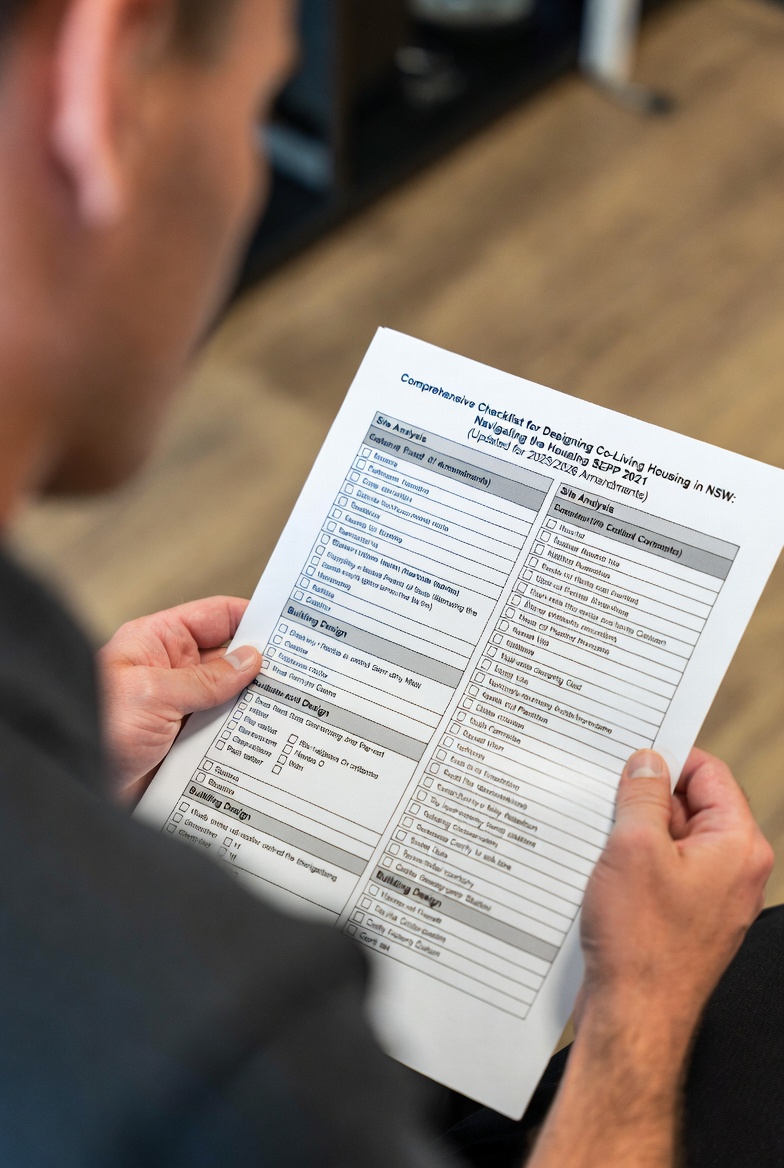
Comprehensive Checklist for Designing Co-Living Housing in NSW: Navigating the Housing SEPP 2021 (Updated for 2025/2026 Amendments)
Co-living housing has emerged as a popular solution to NSW's housing affordability crisis, offering shared amenities and private rooms in a community-focused environment. Under the State Environmental Planning Policy (Housing) 2021—commonly known as the Housing SEPP, as amended up to 2025/2026—this development type provides incentives for diverse, high-amenity housing. However, navigating permissibility, non-discretionary standards, and local controls is crucial to secure approvals and avoid delays or appeals in the Land and Environment Court.
As specialists in architectural compliance and disability access consulting at Sydney Access Consultants, we help architects integrate inclusive design principles from the outset. This checklist draws from Chapter 3 Part 3 of the Housing SEPP (clauses 67–70), related provisions, and practical DA applications. It emphasizes mandatory requirements, non-discretionary standards (which prevent refusal if met), and best practices for amenity, character, and accessibility. Note: Co-living developments are exempt from the Apartment Design Guide (ADG) under SEPP 65/Housing SEPP Chapter 4, relying instead on SEPP standards, local Development Control Plans (DCPs), and merit-based assessments.
Whether you're designing in Sydney's urban centers, emerging Perth markets (where sensitivities to trading names like "Sydney" may require localized branding), or the Mid North Coast—where our partner Sandy Grey offers on-site expertise from Black Beach—this guide minimizes risks and enhances project outcomes. Always cross-reference the current consolidated Housing SEPP on the NSW Legislation website for precise clause wording, as amendments (e.g., 2025 diverse housing updates) continue to evolve.
1. Site Suitability and Permissibility
Selecting the right site is foundational to a successful co-living project. Non-compliance here can lead to outright refusal, so verify early.
- Zoning Confirmation: Ensure the site is in a permissible zone, such as R3 Medium Density Residential, R4 High Density Residential, or B1–B4 business zones where residential flat buildings or shop top housing are allowed. Post-2025 amendments under Chapter 6 (Low and Mid-Rise Housing) explicitly permit co-living in these areas, aligning with transport-oriented development (TOD) goals.
- Minimum Lot Size: Sites must be at least 600 m² in R2 Low Density Residential zones (if locally permitted) or 800 m² elsewhere, per post-2022 simplification amendments. This supports efficient shared space integration.
- Site Frontage: Aim for a minimum of 17 m to facilitate access and vehicle maneuvering—check your local council's DCP for specifics, as narrower frontages can complicate approvals.
- Overlay Restrictions: Avoid sites with heritage conservation areas, flood-prone land, bushfire risks, or other environmental overlays that could prohibit development. Conduct early site audits to identify issues.
- Proximity to Amenities: Prioritize locations near public transport, services, and activity centers to meet local objectives. For Mid North Coast projects, Sandy Grey's local knowledge ensures alignment with regional character, boosting feasibility.
By addressing these early, you reduce assessment risks and position your project for incentives like FSR bonuses.
2. Core Definition and Operational Requirements
Co-living must meet the Housing SEPP's definition to qualify for streamlined approvals. Operational details are key to maintaining its residential character.
- Minimum Private Rooms: Include at least 6 private rooms, with some or all featuring private kitchens or bathrooms. This distinguishes co-living from other typologies like boarding houses.
- Occupancy Limits: Each room accommodates no more than 2 people, ensuring density aligns with amenity standards.
- Residency Focus: The development must serve as a principal place of residence with minimum 3-month tenancies. Prohibit short-term tourist accommodation through a robust plan of management to avoid reclassification as a hotel or serviced apartment.
- Furnishing and Readiness: Provide fully furnished private rooms and shared spaces, ready for immediate occupancy.
- Management Oversight: Appoint a 24-hour managing agent, detailed in the plan of management. This covers maintenance, security, and tenant rules.
- Exclusions: Differentiate from backpackers' accommodation, group homes, seniors housing, or hotels to comply with SEPP intent.
Incorporate these into your DA documentation to demonstrate compliance and prevent operational challenges post-approval.
3. Private Room Design (Non-Discretionary Standards)
Private rooms are the heart of co-living—meeting these minimums is non-discretionary, meaning consent authorities cannot refuse if achieved.
- Floor Area Minimums: 12 m² for single occupants (excluding private kitchen/bathroom) and 16 m² for doubles. These ensure basic livability without overcrowding.
- Maximum Room Size: While not strictly mandated, practice often caps rooms at around 25 m² to preserve the co-living ethos; review local DCPs for any caps.
- Natural Light and Ventilation: Every room must have access to natural light, ventilation, and outlook. Draw on solar access principles (similar to ADG) for defensibility in appeals, enhancing resident well-being.
These standards promote high-amenity designs, reducing vacancy risks in competitive markets like Sydney or Perth.
4. Communal Facilities and Amenity (Non-Discretionary Standards)
Shared spaces define co-living's appeal—failure here can undermine approvals, so prioritize usability and solar access.
- Indoor Communal Living Area: Provide at least 30 m² base plus 2 m² per additional private room beyond 6. Ensure a minimum 3 m dimension in each area for functional flow.
- Outdoor Communal Open Space: Target 20% of site area (or equivalent per post-amendments), integrated with landscaping for recreation.
- Shared Facilities: Include communal kitchens, bathrooms, and laundries if not provided privately. Scale to occupancy for equity.
- Solar Access: Achieve at least 3 hours of direct sunlight (9 am–3 pm mid-winter) to at least one communal living area, supporting mental health and energy efficiency.
- Landscaped Areas: Meet residential controls from DCPs or Chapter 6, with deep soil planting where possible.
These elements foster community while aligning with BASIX requirements for sustainability.
5. Built Form and Density Incentives (Non-Discretionary)
Leverage SEPP incentives to maximize yield without compromising form.
- Floor Space Ratio (FSR): Access the LEP maximum plus a 10% bonus if dedicated to co-living—ideal for infill sites.
- Building Height: Adhere to LEP limits (no standard bonus unless affordable housing is included).
- Setbacks and Separation: Follow residential flat building standards for privacy, akin to ADG separations, to mitigate neighbor impacts.
- Parking Provisions:
- Car parking: Lesser of LEP/DCP rates or 0.5 spaces per room in Greater Sydney (bicycle/motorcycle minimums were removed from SEPP in 2022—defer to local DCPs).
- Integrate EV charging and shared mobility for modern appeal.
- Bicycle and Motorcycle Parking: Provide at least 1 space per room or per 5 rooms, per DCP, to encourage sustainable transport.
These incentives make co-living viable in high-demand areas, from Sydney to regional NSW.
6. Other Design and Amenity Standards
Beyond non-discretionary elements, focus on merit-based aspects to strengthen your DA.
- Privacy and Acoustics: Ensure separation between rooms and neighbors, with noise mitigation for communal areas—critical for long-term livability.
- Accessibility and Universal Design: As access consultants, we strongly recommend incorporating Livable Housing Design Guidelines (Silver level or higher) for step-free entries, wider doorways, and adaptable features. Align with Australian Standards like AS 1428.1 (2021 edition) for accessible paths, and consider NDIS/SDA principles for inclusivity. This not only broadens market appeal but future-proofs against evolving Building Code of Australia (NCC 2025) requirements. For Mid North Coast projects, Sandy Grey's expertise in adaptable housing (AS 4299-1995) ensures seamless integration.
- Sustainability Features: Comply with BASIX for waste, energy, and water, incorporating best practices like green roofs.
- Landscape and Open Space: Design high-quality, usable areas with structured planting if site-constrained.
- Street Presentation: Activate ground levels with responsive materials and entries to enhance local character—key for council assessments.
- Plan of Management: Draft a comprehensive document covering operations, maintenance, and security.
These standards elevate your project, reducing appeal risks on amenity grounds.
7. Documentation and DA Readiness
Robust documentation is your best defense—prepare thoroughly for smooth processing.
- Compliance Statement: Include a clear address of non-discretionary standards to leverage "cannot refuse" protections.
- Design Statement: Respond to local character, heritage, and urban design (e.g., Clause 6.5 design excellence in some LEPs).
- DCP Cross-Referencing: Align with objectives on solar access, open space, and amenity, even if not mandatory.
- BASIX and Targets: Submit certificates demonstrating energy and water efficiency.
- Chapter 6/TOD Alignment: If in low/mid-rise or TOD precincts, confirm overrides apply (co-living permissible post-2025).
For complex sites, seek pre-DA advice and specialist input. At Sydney Access Consultants, our team—including qualified access experts like Sandy Grey—supports seamless compliance.
By following this checklist, architects can deliver compliant, inclusive co-living projects that meet NSW's housing needs. For tailored advice, especially on accessibility integrations, consider consulting specialists early in the design process.