

Navigating Development Consent for Co-Living Housing in NSW: Essential Guide for Developers and Architects
Co-living housing has emerged as a popular solution to NSW's housing affordability crisis, offering shared living spaces that foster community while providing private rooms and communal amenities. However, constructing co-living developments in New South Wales isn't straightforward. Unlike traditional residential projects, co-living requires careful navigation of planning laws to ensure compliance and successful approvals. In this article, we'll break down the key requirements under the Environmental Planning and Assessment Act 1979 (EP&A Act) and the State Environmental Planning Policy (Housing) 2021 (Housing SEPP), with a focus on permissibility, consent pathways, and the often-overlooked role of accessibility in design. As specialists in inclusive design, we'll also highlight how integrating universal access principles from the outset can streamline your project and avoid costly revisions.
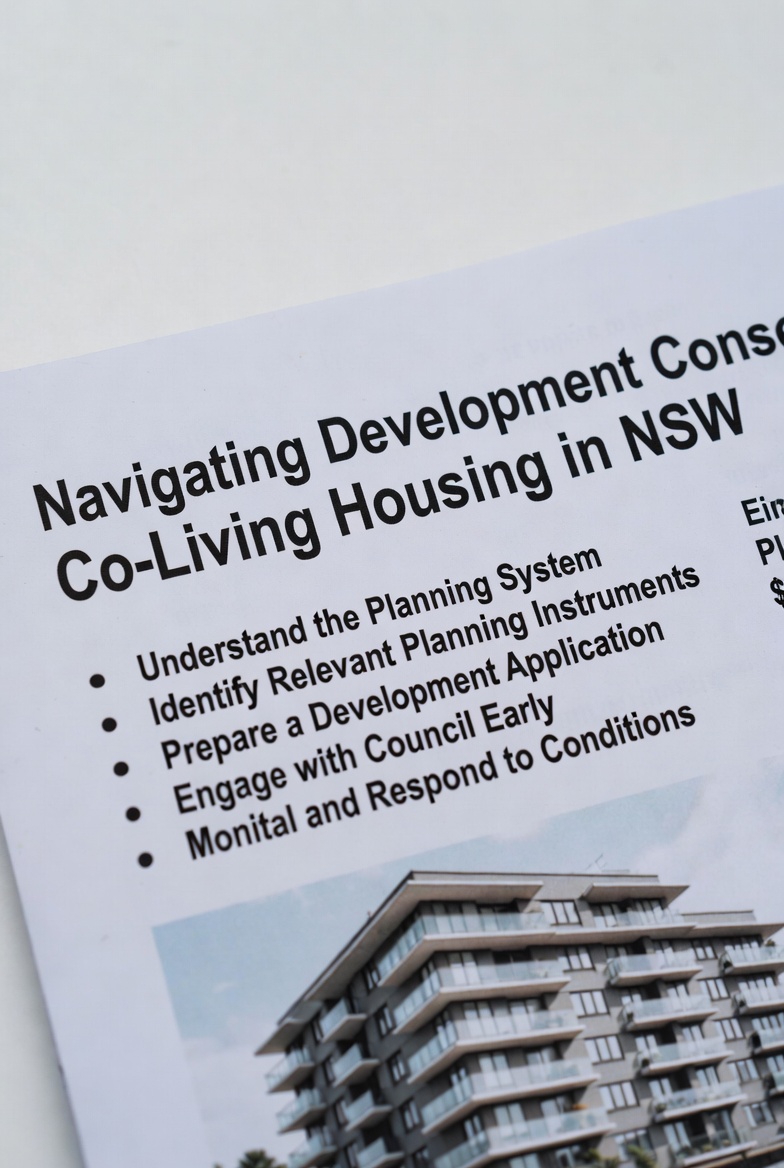
Understanding Co-Living Housing in NSW: What It Is and Why Consent Is Required
Co-living housing, as defined in the Housing SEPP, typically involves buildings with private rooms (minimum 12m² for singles or 16m² for couples) combined with shared kitchens, living areas, and outdoor spaces. It's designed for long-term residents with minimum three-month tenancies, distinguishing it from short-term accommodations like hostels or tourist housing.
Under the EP&A Act, co-living developments generally require development consent. They are not classified as exempt or complying development under the Housing SEPP or the State Environmental Planning Policy (Exempt and Complying Development Codes) 2008. This means every proposal must go through a full development application (DA) process, assessed against Section 4.15 of the EP&A Act, which considers environmental, social, and economic impacts.
Why no shortcuts? Exempt or complying pathways are reserved for low-impact developments like certain granny flats or group homes with strict size limits. Co-living's scale and shared nature demand thorough review to ensure it aligns with local character, infrastructure capacity, and amenity standards.
Key Provisions from the Housing SEPP: Permissibility and Zones
Chapter 3, Part 3 of the Housing SEPP outlines the core rules for co-living housing. As of the latest consolidated version (incorporating 2025 amendments for low and mid-rise housing reforms), Clause 67 permits co-living with consent in zones where:
- Co-living is explicitly allowed under another environmental planning instrument, or
- Residential flat buildings or shop top housing are permitted under Chapter 5 (Diverse Housing), Chapter 6 (Low and Mid-Rise Housing), or the local council's Local Environmental Plan (LEP).
This opens doors in zones like:
- R3 Medium Density Residential
- R4 High Density Residential
- Commercial zones such as B1 Neighbourhood Centre, B2 Local Centre, or B4 Mixed Use
Recent reforms have expanded permissibility near transport hubs and centres via Chapter 6, but co-living remains prohibited in R2 Low Density Residential zones to preserve suburban character.
| Zone Type | Permissibility for Co-Living | Examples |
|---|---|---|
| R3 Medium Density | With consent (if flats allowed) | Townhouses, villas, or apartments |
| R4 High Density | With consent | High-rise residential towers |
| B4 Mixed Use | With consent (shop top housing) | Developments above retail or offices |
| R2 Low Density | Generally prohibited | Single dwellings, dual occupancies |
Non-discretionary standards under Clause 68 provide bonuses and safeguards:
- Floor Space Ratio (FSR): Up to 10% bonus beyond the LEP maximum, if used exclusively for co-living.
- Room sizes, communal spaces, solar access, landscaping, and parking requirements ensure livability.
- Clause 69 mandates satisfaction of these before consent, but authorities can't refuse solely on non-compliance—they must weigh overall merits.
Subdivision into separate lots is banned under Clause 70 to maintain the shared model.
The Consent Process: Who Approves and What to Expect
The local council is usually the consent authority, handling DAs through standard processes. Exceptions include State Significant Development (SSD) for large-scale projects exceeding thresholds (e.g., over $30 million in capital value), but most co-living falls below this.
Assessment involves:
- Submission via the NSW Planning Portal, including plans, statements of environmental effects, and a plan of management (often conditioned for ongoing operations, like 24/7 manager availability).
- Holistic review under s 4.15, considering LEP zones, Development Control Plans (DCPs), and impacts like traffic or overshadowing.
- Potential integrated approvals from agencies (e.g., NSW Health for sanitation in shared facilities).
Local DCPs may add layers, such as design excellence or heritage considerations, but can't override SEPP non-discretionary standards. Appeals can go to the Land and Environment Court if refused.
Practical tip: Always verify the current Housing SEPP on legislation.nsw.gov.au, as 2025 updates aligned it with Transport Oriented Development (TOD) policies, potentially fast-tracking approvals near stations.
Accessibility Considerations in Co-Living Housing: Building Inclusive Communities
While the Housing SEPP focuses on planning, co-living must comply with the National Construction Code (NCC) 2022 (current as of 2026) for building standards, including accessibility under the Disability (Access to Premises—Buildings) Standards 2010. Co-living's shared spaces amplify the need for universal design—think accessible entries, bathrooms, and kitchens to accommodate diverse residents, including those with disabilities.
Key NCC clauses:
- Volume 1, Part D4: Access to and within buildings (e.g., ramps, lifts for multi-level co-living).
- AS 1428.1-2009 (Design for Access and Mobility): Minimum requirements for paths, doors, and sanitary facilities.
- Livable Housing Design Guidelines: Silver or Gold level recommended for co-living to future-proof against NDIS or aging-in-place needs.
Non-compliance risks delays or retrofits. For instance, communal areas must provide equitable access, avoiding "accessible units" in isolation. Performance solutions (alternative designs justified via expert reports) can offer flexibility, but require robust documentation.
As access consultants, integrating these early avoids common pitfalls like inadequate circulation spaces or non-compliant gradients, ensuring your co-living project not only gets consent but also delivers social value.
Practical Tips for Successful Co-Living Developments in NSW
- Site Selection: Target zones with existing flat building permissions. Use tools like the NSW Spatial Viewer to check LEPs.
- Pre-DA Advice: Engage councils early for feedback on bonuses or variances.
- Design Integration: Incorporate communal features (e.g., 25% indoor communal space) to qualify for FSR uplifts.
- Risk Mitigation: Prepare for objections on density or parking—strong traffic studies help.
- Sustainability Tie-In: Align with BASIX requirements for energy efficiency, enhancing appeal.
For site-specific guidance, review your suburb's LEP (e.g., Sydney LEP 2012 for inner-city zones). If heritage, flood-prone, or near sensitive areas, expect additional scrutiny.
Why Partner with Access Experts for Your Co-Living Project?
Co-living's emphasis on community demands designs that are truly inclusive. By embedding accessibility from concept stage, you comply with NCC standards, reduce approval risks, and attract a broader tenant base. Our team at Sydney Access Consultants specializes in performance solutions, audits, and compliance reviews tailored to diverse housing like co-living, drawing on Australian best practices to bridge gaps in local enforcement.
Whether you're an architect planning a medium-density project in Parramatta or a developer eyeing mixed-use in Newcastle, understanding these rules is key to success.