

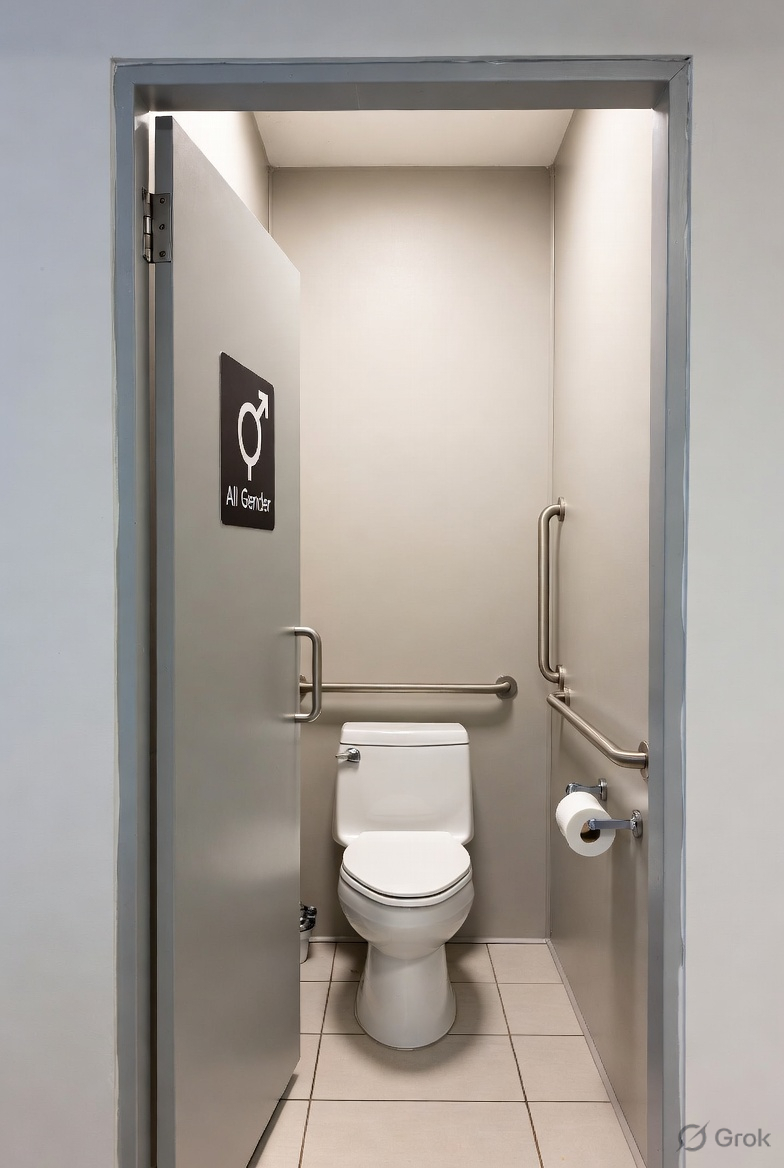
Single-occupant all-gender accessible sanitary facility interior, featuring WC, handbasin, sanitary disposal bin, grab rails, full-height partitions, and clear signage
The NCC 2025 preview, released by the Australian Building Codes Board in early February 2026, introduces a valuable optional Deemed-to-Satisfy (DTS) pathway in Volume One, Part F4, for all-gender sanitary facilities. This allows building owners and designers to incorporate all-gender compartments alongside traditional male and female facilities in Class 2 to 9 buildings, such as offices, retail centres, schools, community venues, and multi-residential developments.
The provision uses clear substitution rules to maintain total fixture counts while promoting inclusivity:
- For setups requiring only 2 closet pans (one male, one female), both can become all-gender.
- For 3 pans or urinals total, one all-gender facility can substitute, as long as at least one male and one female remain.
- For 4 or more fixtures, up to half (balanced equally between male and female quotas) can be converted to all-gender, ensuring that mandatory female facilities with sanitary product disposal remain prioritised.
Each all-gender compartment must be single-occupant, equipped with a WC, handbasin, sanitary disposal, and full-floor-to-ceiling privacy partitions to ensure safety, dignity, and hygiene. Access comes from non-gendered circulation spaces.
This update enhances inclusivity for gender-diverse users, including non-binary, transgender, and other gender-diverse individuals, while supporting broader needs such as families with children, caregivers of all genders, and people requiring assistance. It aligns with universal design principles and complements existing accessible sanitary requirements under AS 1428 and NCC provisions.
Building owners and developers gain real advantages. All-gender options reduce queuing times by sharing capacity more efficiently among users, based on evidence from queueing studies (e.g., Ghent University research showing that unisex/shared facilities can cut women's average wait times from over 6 minutes to under 1.5 minutes, with overall improvements of up to 63% in balanced layouts). Shorter queues improve user satisfaction, event flow in venues like shopping centres or community buildings, and overall amenity experience for tenants and visitors.
This flexibility can also optimise space and costs in design, as efficient fixture use avoids over-provisioning while meeting code minima. For Co-Living housing or adaptable housing projects, these options support person-centred privacy and dignity in shared or multi-occupant settings, especially when paired with accessible features.
In NSW, the optional DTS pathway simplifies compliance without needing Performance Solutions for all-gender provisions (previously common). It lets architects deliver forward-thinking, equitable designs that attract diverse tenants, boost reputation for inclusivity, and future-proof buildings.
Mid North Coast specialist Alexandra (Sandy) Gray brings practical expertise in inclusive design, audits, and adaptable housing. Her local knowledge helps integrate these provisions into projects for compliant, user-focused outcomes that enhance accessibility and reduce operational hassles like long queues.